
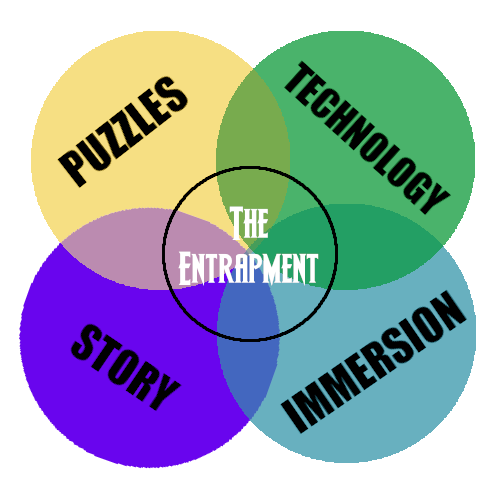
The process interates again and a again until slowly puzzles grow organically into the story and therefore are not out of place. If we are trying to get into an abandoned house there wouldn't be an electronic lock on the door as that would be out of place. Unless the lock is foreshadowing that maybe this house isn't as abandoned as it seems.
We try and invent new types of puzzles we have never seen before. Sometimes it may draw an element from something we saw somewhere or it may simply be something that popped into mind while writing the story. We ask questions like "should there be technology in this puzzle or not?" and "is this a puzzle that should take 2 minutes to solve or 10 minutes?"
We also like to add layers to our puzzles. When you approach a puzzle during the experience you may only have a small amount of the information you need to solve it. Interacting with the puzzle may provide more information that makes information that you have make sense. There may yet be another level to the puzzle once you think you've got it solved, providing an "ah ha!" moment.
We are always on the look out for new and unusual sensors and interactive gadgets that might somehow fit into the experience we are building. Some sit unused for years until the right place to insert them comes along, while others are still collecting dust.
Using tecnology while forward looking also provides us the ability to change the experience slightly each time it is played, or to reprogram something entirely for a new puzzle like we do with our Seasonal Room Overlays (see the Rooms page for more information).
Elements in the space you entered should feel both familar yet new. Things that are puzzles should not stick out like a sore thumb. They should be themed and make sense in the space they are in and perhaps offer a suggestion that there is more to it than meets the eye.
Immersion doesn't end at what you see but should include what you hear! If you're in a warehouse there should be strange creaks and the shuffling of some creature in the rafters overhead or behind a box. If you're in a mountain cabin there should be wind and perhaps the sounds of a nearby stream.
These are things we think about even when we know many people will never recognize they are there. It's when you recognize that they are NOT there that it is a problem.
Let Us Help Design Your Next Experience!

Whether you are looking for a single puzzle or the entire game, The Entrapment, can help!
Shoot us an email and let's start talking.
info@theentrapment.com